
Navigating transformation of biodiversity and climate

Science Advances (Editorial)

November 27, 2019
[…] Ours is a bioclimatic world in which every organism, from bacterium to blue whale, inseparably contributes to the climate and surface conditions of Earth. This tapestry, of which we are a part, is unraveling, with its delicate patterns and motifs denigrated to near invisibility, disappearing at a rate and magnitude that rivals that of the great mass extinction events of the past. This fading to nonexistence is making us unfortunate witnesses to the accumulated consequences of human actions over the past 10,000 years. Happily, though, we are now increasingly empowered by science and can act to abate ongoing trends and protect planetary resources before the essential threads of life’s coherence become completely eroded.
Read Full Piece

Indigenous protectors of these sacred peaks have kept others out—until now

National Geographic

November 27, 2019
The Arhuaco invite National Geographic to the upper reaches of their Colombian homeland to reveal threats we all face—and remind us of our roots in nature.

[…] Breaking with their rigidly isolationist past, they invited photographer Stephen Ferry and me to join them on a spiritual journey from the base of the massif all the way up to a sacred lake called Naboba, fed by glacial melt at nearly 16,000 feet. They want us to be their megaphone to the wider world about the threats to the Sierra Nevada, to their way of life—and to humanity.

Read Full Article

$10M in prize money for mapping rainforest biodiversity

Mongabay

November 27, 2019
Efforts to catalog the fast-declining biodiversity of tropical rainforests just got a $10 million boost via a new competition from XPRIZE, an organization that has more than a dozen competitions on topics ranging from spaceflight to oil cleanup over the past 25 years.

Last week, XPRIZE formally unveiled the $10 million Rainforest XPRIZE to catalyze development of “technology capable of identifying and cataloging rainforest biodiversity” that can underpin the emergence of new bioeconomy based on the value of standing forests as heathy and productive ecosystems.

Read Full Article

7,000 African plant species at risk of extinction due to climate change

International Business Times

November 22, 2019
About one in every three plant species in Africa is at the risk of extinction due to climate change, a study has revealed. Researchers classified about 7,000 out of more than 22,000 vascular plant species in Africa as "likely or potentially" threatened, the report said, pointing towards the losses of biodiversity, rapid human population growth, changes in land use, and the effects of changing the climate as reasons behind the disappearance.

Read Full Article

Children Are Particularly Vulnerable to Climate Change's Health Impacts

Scientific American

November 14, 2019
Children born today will face a lifetime of climate change-related health problems, one of the world's oldest and most prestigious medical journals warns in a report released yesterday.

The Lancet's "Countdown: Tracking Progress on Health and Climate Change" says the new era of climate change will "define the health of an entire generation" — unless there is significant intervention.

Read Full Article

What vision do we have for the deep sea?

Phys.org

November 14, 2019
The ocean hosts an inconceivable wealth of marine life and diverse habitats, most of which remains unknown and unseen. International plans to mine minerals from the deep seafloor threaten this largely unexplored biodiversity hotspot. States are currently seeking to develop a legal framework for deep seabed mining. In cooperation with the Heinrich Böll Foundation, an international team of researchers from the Institute for Advanced Sustainability Studies (IASS) has published a new study warning against a rush to exploit deep seafloor resources and calling for coordinated efforts to develop alternative approaches.

Read Full Article

To save wildlife, African governments turn to private management

National Geographic

Screenshot 2019-11-12 10.52.15.png

November 12, 2019
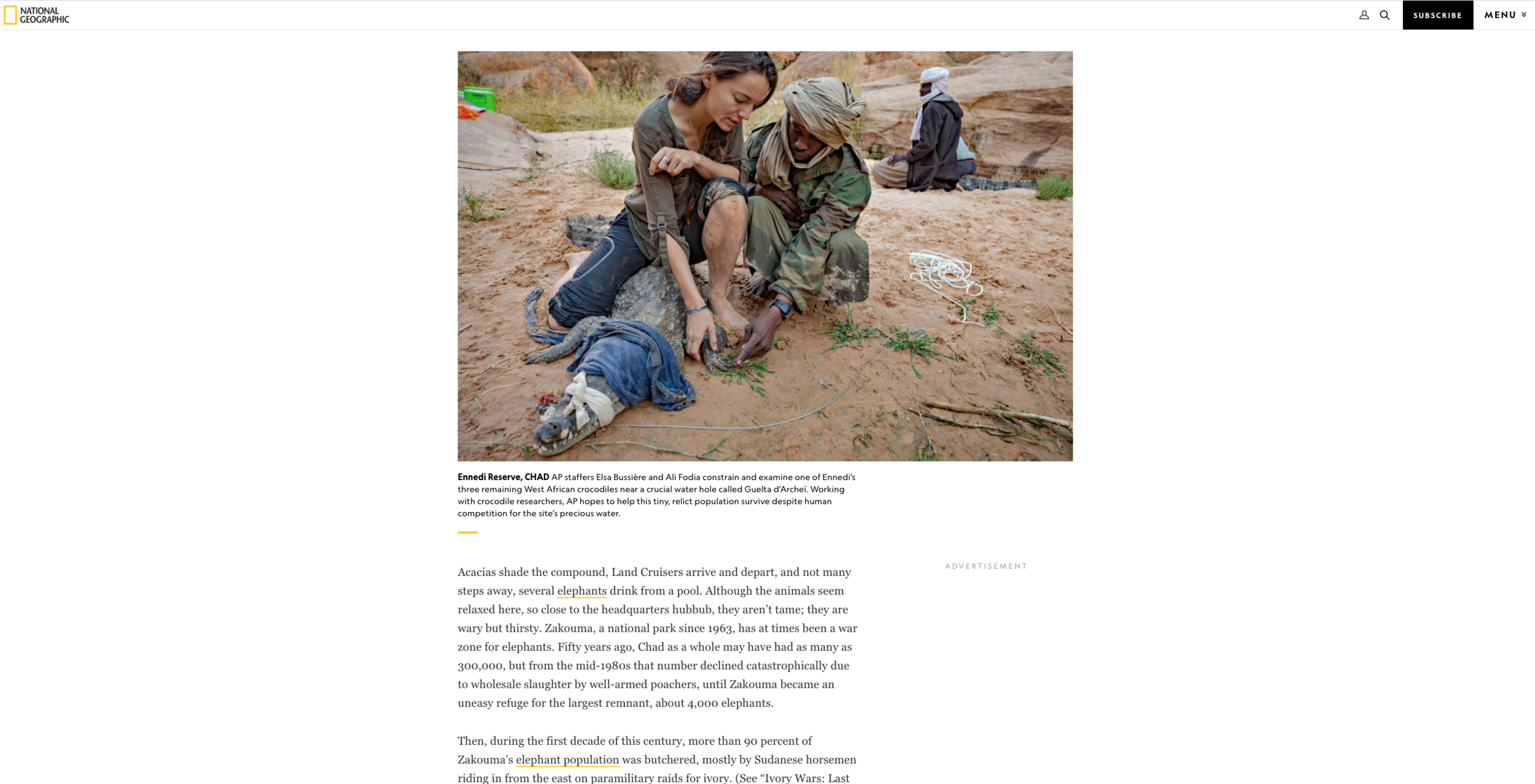
The headquarters at Zakouma National Park, in southeastern Chad, is a sand-colored structure with a crenellated parapet that gives it the look of an old desert fortress. Outside the door to the central control room on the second floor hangs an image of a Kalashnikov rifle, circled in red, with a slash: No weapons allowed inside. Kalashnikovs are ubiquitous in Zakouma. All the rangers carry them. So do the intruders who come to kill wildlife.

Read Full Article

They've managed the forest forever. It's why they're key to the climate change fight

Phys.org

November 8, 2019
[…] More than 600 indigenous communities live in Canada's boreal forest, one of the last great swaths of intact wilderness on Earth. But every year, a million acres fall to logging to make timber and tissue products, including toilet paper sold in the U.S., according to the Natural Resources Defense Council. That's seven hockey rinks' worth of forest every minute.

Canada's First Nations, with help from groups such as the NRDC and Greenpeace, want to stanch the losses and protect the lands their ancestors have depended upon for centuries—or longer.

Read Full Article

Global Landscape of Climate Finance 2019

Climate Policy Initiative

November 8, 2019
Four years after world leaders negotiated the Paris Climate Agreement, now signed by 195 countries around the world and ratified by 187, national policies and market signals are starting to reflect the urgency both of increasing finance for mitigation of and adaptation to the effects of climate change, and of making all financial flows consistent with a pathway toward low-carbon and climate-resilient development. However, much more ambition will be needed to avoid the most catastrophic effects of climate change, including a push at the national level for countries to meet and exceed their climate action plans.

Read Full Article

The human health benefits of conserving and restoring peatlands

UN Environment Programme

November 8, 2019
It is well known that peatlands matter for livelihoods, carbon storage, flood mitigation, and water quality, but a recent study has shown that peatlands also matter for human health.

The study suggests that thousands of deaths could be prevented over the next three decades across Indonesia, Malaysia and Singapore through improved land management to reduce the number and extent of peatland fires. The fires contribute to dangerous levels of particulate matter harmful to human health. Air quality near large population centres could improve significantly, saving lives, the study found.

Read Full Article